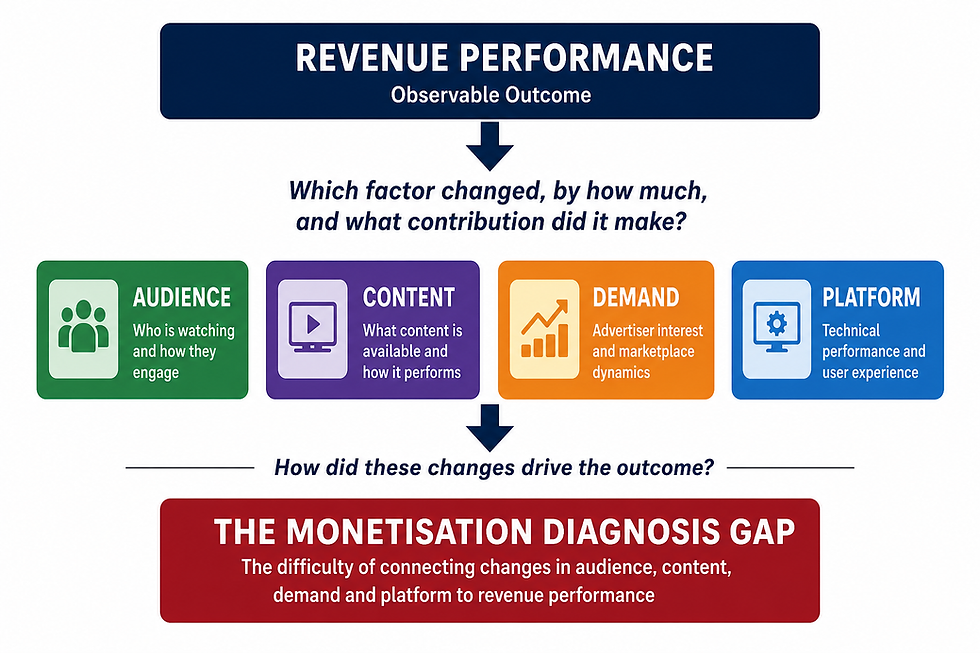
The Video Revenue Stack Is Getting Smarter. Who Explains the Revenue?
Updated: Sep 3
AI is advancing across media buying, publisher sales, advertising operations and streaming platforms. The opportunity is not to replace that intelligence, but to organise it around the commercial outcome the video business is trying to understand.

No single platform is driving all the change in video advertising. AI and automation are arriving from many directions.
Buyer platforms are introducing agents for planning, analysis and campaign action. Publisher sales systems are preparing for agent-to-agent transactions. Supply and operations platforms are using AI to understand demand and find problems across connected systems. Video platforms are applying AI to advertising, audience experience and the coordination of streaming services.
Some of these capabilities remain close to a particular workflow. Others already cross several systems and functions. All represent meaningful progress.
But a more intelligent stack does not automatically give the video business a clear explanation of its revenue.
Three perspectives, one commercial question
If you lead video advertising sales or operations, you need to know why revenue moved and which setting, process or commercial decision can be changed safely.
If you run the video business as a whole, you need to understand how audience, content, experience, distribution and monetisation combined to produce the result—and what it means for the wider P&L.
If you provide a video platform or bundled monetisation service, you may be expected to answer both questions, even when delivery, decisioning and demand depend on specialist adtech partners.
These responsibilities may sit in three different organisations or within one provider. Either way, the central question is the same:
When advertising revenue changes significantly, can the business explain the combined result—and decide what to do next?

The responsibilities may sit in separate organisations—or within one provider.
How we arrived here
The first article in this series introduced the monetisation diagnosis gap: the distance between seeing that revenue has changed and understanding why.
The second challenged the dashboard illusion. A platform can be authoritative for the events it observes without explaining the complete commercial outcome.
The third examined the cost of slow diagnosis. When evidence is collected manually, one source after another, decisions are delayed and revenue that could have been recovered can be lost.
Recent announcements suggest that the market is starting to move quickly. AI is making evidence easier to examine and actions faster to carry out. At the same time, IAB Europe’s 2026 work on CTV still describes fragmented measurement, inconsistent standards and limited supply-chain transparency. The core gap remains: how does the business combine its available intelligence across systems and organisations?
Start with the revenue change
Most platform intelligence begins with something inside the environment concerned:
- Why is this campaign failing to deliver as planned?
- Why has demand weakened for this inventory?
- Where are impressions being lost?
- Which price, allocation or targeting control should change?
Those are valuable questions. A business-level investigation starts one level higher:
Why did net advertising revenue change, which factors contributed, what remains uncertain, and what coordinated decision should follow?
Answering it requires a simple commercial model connecting the parts of the video business:
Audience and viewing → content and device mix → monetisable opportunities → eligible and delivered ads → demand and price → gross revenue → fees and revenue shares → net revenue

No single system has to own that whole chain. A viewing platform may explain consumption. An ad server may explain decisions and delivery. A supply platform may explain bids and demand. A bundled provider may coordinate several of them. Finance and partner reports may explain how gross revenue became net revenue.
The objective is not to replace those sources with another universal dashboard. It is to assemble their evidence around one commercial question.
Orchestration needs an objective
This becomes more important as platforms built around AI agents emerge.
A quality-of-experience agent may reduce buffering. A retention agent may trigger an offer. A monetisation agent may increase ad load or change an allocation. A yield system may maximise fill or price. Each can succeed against its own objective while the business remains unable to explain the combined revenue effect.
The important question is therefore not only what the technology can coordinate. It is who that coordination is working for and which outcome guides the choices when goals conflict.
For a video business, that means stating the commercial objective clearly. It also means setting limits and safeguards around viewer experience, campaign obligations, privacy, partner agreements and longer-term customer value.
An orchestration platform could provide access to data, workflows and systems that can take action. Existing advertising systems could provide specialist analysis and carry out changes. Where the business still cannot explain a significant revenue change, our framework brings together evidence from those systems, tests possible causes and builds a supported answer.
The Video Advertising Revenue Diagnosis Framework
This is the progression the series has been building towards. The first three articles established why revenue diagnosis breaks down. The practical takeaway from this article is a reusable Video Advertising Revenue Diagnosis Framework.
Its unit of analysis is not a campaign, ad request or platform KPI. It is a significant movement in the video business’s net advertising revenue.
It is not another universal platform. It is a commercial and technical framework that can be configured to the customer’s business, systems and partner environment. It has five connected elements:
1. A business trigger: one clearly defined revenue movement, with an agreed baseline, scope and trigger for investigation—such as a percentage variance, cash value or duration.
2. A revenue model: deterministic decomposition of the movement across audience, mix, ad opportunities, delivery, demand, price, fees and revenue shares.
3. An evidence map: the relevant metrics, definitions, counting points and data owners across internal systems and external partners.
4. A diagnostic engine: AI-assisted formation and testing of competing hypotheses, using approved sources and parallel analysis where possible.
5. A decision layer: one shared case, a stated level of confidence, role-specific briefs and clear ownership of the next action.
The framework is anchored to the video business outcome, regardless of who owns or operates the systems contributing evidence.

These are not five slow, sequential stages. They work together. As soon as a case opens, the framework can show where the change is concentrated, which explanations are most plausible, what evidence is missing and which decision can already be made safely.
AI accelerates the work across the framework. It can retrieve evidence, map different identifiers and definitions, test hypotheses in parallel and maintain the case as new information arrives. The revenue calculations, evidence rules and decision rights provide the control around it.
One shared diagnostic case
The framework’s practical unit of work is a shared diagnostic case: one record of the question, revenue decomposition, hypotheses, evidence, conclusions and actions.
The case keeps the numerical breakdown separate from the possible causes, the supporting evidence and the resulting decision. This matters because decomposition does not prove causality, and a convincing AI-generated explanation is not the same as a supported conclusion.
Calculations should be deterministic and reproducible. Each important conclusion should link back to its source. The case should show where information is missing or sources disagree. Consequential actions remain with an authorised decision-maker.
Participants do not need access to every underlying record. Content owners, platform providers and adtech partners can use permissioned views and focused evidence requests while working from the same business question. That does not remove commercial disagreement, but it makes competing claims explicit and tests them against evidence.
What faster visibility looks like
Consider an illustrative case in which a content owner’s weekly net video advertising revenue is 18% below its recent baseline.
Viewing has grown. The ad server reports broadly stable fill. A supply partner reports weaker pricing. The platform revenue report confirms the lower revenue. Every statement may be correct, but none explains the result alone.
The first breakdown shows that the change is concentrated in specific content, device and distribution cohorts. Viewing has risen, but the new mix creates fewer eligible ad opportunities. On one device, impressions are lost after the ad-server hand-off. Effective price has also declined as the demand mix changes. A difference in reporting dates explains a smaller part of the net change.
The answer is not simply that fill fell or demand weakened. It is a combination of business mix, delivery and price effects seen by different participants.
That visibility can arrive before every cause is fully confirmed. The advertising leader can protect the affected inventory and test low-risk changes that can be reversed. The video executive can see the likely financial impact and the choices involved. The platform or bundled provider can focus the next partner request and turn evidence from several sources into a clear customer explanation.
One case produces three decision summaries, but not three competing versions of the truth.
A practical test for the business
The framework is designed to work with the market, not deny what existing platforms can already do. In some environments, one platform may answer most of the business question. In others, the answer may depend on evidence and decisions spread across the content owner, platform provider, adtech partners and finance.
That gives any video business a practical test. Take one significant revenue movement and ask:
- Can we decompose it across audience, mix, opportunities, delivery, demand, price and deductions?
- Can we distinguish what is observed, calculated, inferred and still unknown?
- Can we identify the evidence required, where it sits and who controls it?
- Can we give each decision-maker a relevant view without creating competing explanations?
- Can we identify the next justified action, its owner and the confidence behind it?
If the answer is yes, the business may already have the capability it needs. If not, the remaining gap is no longer an abstract concern about fragmented technology. It is a defined management and intelligence problem.
For a content owner, closing that gap can strengthen control of advertising performance and external partners. For a bundled provider, it can support a more transparent, intelligence-led service. For an orchestration platform, it can provide a concrete commercial objective around which specialist agents can work.
From intelligent platforms to an intelligent business
The opportunity is not another promise to see everything.
The video business does need a faster, disciplined way to begin with a significant revenue change, use the strongest available intelligence, show what remains uncertain and coordinate the decisions that follow.
The first three articles established why that capability matters. This article has defined what it must do and how it can work with the technology already reaching the market.
The final question is what changes when this capability becomes part of the way the video business operates: how quickly it can see, decide, act and learn across the boundaries that shape revenue.
That is where the series concludes next.
References
Industry context and methodology
Illustrative market examples
The company announcements below are examples of a wider market direction, not an exhaustive vendor review or endorsement.