
The Monetisation Diagnosis Gap
The monetisation question I keep hearing
Over the past year, I’ve had conversations with broadcasters, streaming platforms, advertising sales organisations and technology vendors across Europe and Latin America. The discussions covered a broad range of topics, including FAST channel strategies, advertising operations, audience growth, platform evolution, measurement challenges and data strategy.
Despite the variety of topics, I found myself returning to the same underlying question. It was rarely asked directly and often sat beneath the immediate topic being discussed, but it appeared often enough to become difficult to ignore:
Why is revenue actually changing?
This question matters because advertising-supported streaming has entered a new phase of maturity. Connected TV advertising is now measured in tens of billions of dollars globally, while broadcasters, telcos and streaming operators continue to expand FAST, AVOD and hybrid subscription-plus-advertising business models.
As these businesses become more dependent on advertising revenue, the financial impact of monetisation performance grows correspondingly. Small improvements in fill rate, audience value or inventory utilisation can translate into significant commercial outcomes.
At the same time, the number of systems involved in generating those outcomes continues to increase. A modern streaming operation may depend on ad servers, SSPs, SSAI infrastructure, player analytics, audience measurement systems, CRM platforms, recommendation engines and cloud data warehouses. Each system generates data. Each produces reports. Each provides a perspective on performance.
Yet few organisations appear to have a coherent way of connecting those perspectives into a single explanation of why revenue moved up or down.
Reporting Is Not the Same as Understanding
One observation surfaced repeatedly during these conversations. Most organisations are reasonably well equipped to report on monetisation performance. They can identify changes in CPMs, fill rates, audience engagement, viewing behaviour or advertising demand. They can usually tell you what happened.
The challenge begins when they attempt to move beyond observation and understand causality.
Knowing that revenue declined is useful. Understanding whether that decline was driven by audience composition, content mix, advertising demand, platform performance or operational decisions is considerably more valuable. The same applies when performance improves. Without understanding the underlying drivers, it becomes difficult to determine which actions should be repeated, scaled or prioritised.
This distinction between reporting and diagnosis struck me as increasingly important. In conversation after conversation, I encountered organisations with no shortage of data but varying degrees of confidence in their ability to explain the relationships between that data and commercial outcomes.
One organisation was seeing audience growth but was uncertain why monetisation performance was not increasing at the same rate. Another was expanding distribution across multiple platforms and trying to understand which operational changes were having the greatest commercial impact. A third had extensive campaign reporting but limited visibility into the factors driving inventory value.
The specific circumstances differed. The underlying challenge felt remarkably similar.
The Monetisation Diagnosis Gap
As I reflected on these conversations, I found myself returning to a simple framework.
Most monetisation outcomes appear to be influenced by four broad categories of factors:
Audience
Content
Demand
Platform
Revenue is ultimately the observable outcome of interactions between those factors.
The challenge is determining which of them changed, by how much, and what contribution they made to the final result.
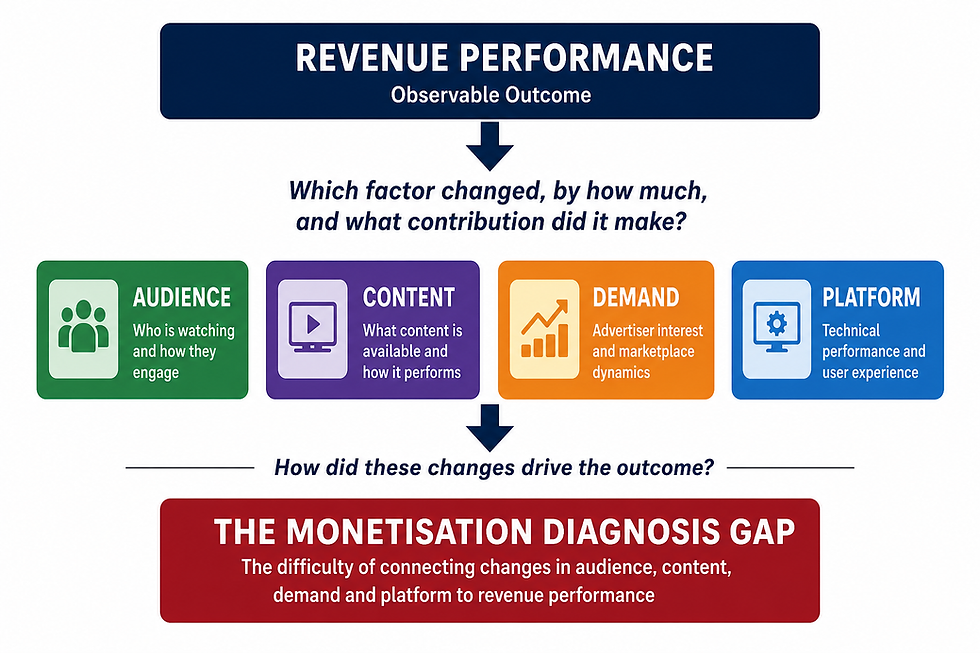
The framework is intentionally simple, but it captures a challenge that appears increasingly common across the industry.
Revenue is relatively easy to observe. The difficulty lies in determining which underlying variables are responsible for changes in that revenue and how those variables interact with one another. In practice, multiple factors often change simultaneously. A decline in monetisation performance may be influenced by audience behaviour, content consumption patterns, shifts in advertising demand and platform experience at the same time.
The more complex the operating environment becomes, the harder it is to separate signal from noise.
It’s Not Just a Data Problem
An interesting variation of this challenge emerges among organisations that have outsourced significant parts of their monetisation infrastructure.
Many FAST operators, content owners and broadcasters rely on external partners for channel distribution, advertising operations or monetisation. In some cases, they conclude that understanding monetisation performance is impossible because they simply do not have access to the underlying data.
There is certainly some truth in that. They may not have impression-level logs, bid-level marketplace data or the operational visibility available to larger streaming platforms.
However, I increasingly suspect that the situation is not as binary as it first appears.
Even organisations with limited transparency often possess valuable signals such as revenue reports, audience trends, content schedules, platform analytics, distribution footprints and historical performance data. While those signals may be incomplete, they are often sufficient to support meaningful diagnosis.
The challenge therefore becomes different rather than smaller. Instead of analysing vast quantities of data, the objective becomes extracting insight from partial information and identifying the most likely drivers of commercial outcomes.
This is one reason I believe the opportunity is broader than many assume. The organisations that need better explanations are not limited to those with sophisticated data infrastructures. In many cases, they are the organisations with the least visibility into what is actually happening inside the monetisation process.
A Challenge That Sits Between Teams
One reason this issue appears difficult to address is that it does not fit neatly within traditional organisational structures.
Commercial teams focus on revenue outcomes. Advertising teams focus on inventory and demand. Product teams focus on user experience and engagement. Content teams focus on programming and audience retention. Data teams manage the information that underpins decision-making.
Each function owns part of the story.
Few own the explanation.
As a result, organisations can find themselves conducting lengthy investigations whenever monetisation performance changes. Different teams often arrive at different interpretations, supported by different datasets and perspectives.
In many ways, the challenge is not a lack of data. It is the difficulty of turning fragmented information into a coherent explanation.
An Emerging Industry Pattern
What has struck me most is not any individual conversation. It is the consistency of the pattern across conversations.
The organisations involved operate in different countries, serve different audiences and pursue different business models. Some are broadcasters. Some are streaming platforms. Some are advertising sales organisations. Some are technology providers.
Yet many appear to be wrestling with variations of the same question: how do we move from measuring monetisation performance to understanding it?
A clear pattern has emerged from these discussions.
Most organisations already possess at least some of the signals required to understand monetisation performance. What is often missing is a consistent framework for connecting those signals to commercial outcomes and identifying the factors that matter most.
This observation has informed the development of a monetisation intelligence framework designed to help organisations diagnose performance across audience, content, demand and platform factors. Recent advances in AI make this particularly interesting, creating the possibility of scaling a level of analysis and interpretation that has historically relied on specialist expertise and manual investigation.
The industry has spent the last decade building systems that tell us what happened. The next challenge may be building the capability to explain why it happened.
I’d be interested to hear whether others are seeing similar challenges in their own organisations.
How do you distinguish between reporting what happened and understanding why it happened?


